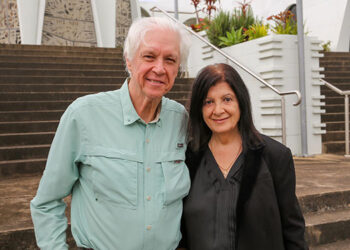
SR Helen Parer is a people person with a heart of gold who will be sorely missed from Charles Darwin University now that she has called it a day after 13 dedicated years with the university.
Sr Helen worked out of the Higher Education building at Alice Springs campus overlooking the majestic MacDonnell Ranges where she played an integral part of CDU’s Adult Literacy Unit as a language and literacy lecturer and work-place assessor.
“It is privileged work. I have been able to share my knowledge with some of the most amazing people while being challenged to expand my vision and ideas about education,” she said.
“Education is power. It’s about equipping people with knowledge so that they can make free decisions about life, about employment, about what to eat, about all sorts of things.”
In February this year Sr Helen achieved a noteworthy personal milestone – her 50th anniversary as a Loreto Sister. Loreto Sisters specialise in the education of women.
Sr Helen’s interests and studies have been in the areas of education, psychology and pastoral care.
She completed postgraduate studies in ESL (English as a second language), special needs, educational counselling, and language, literacy and numeracy practice in VET (Vocational education and training).
While studying in the United States she studied Jungian psychology and she is a certified practitioner of the Myers Briggs Type Indicator. She has worked across Australia in primary, secondary and adult education.
For the past 20 years her focus has been on indigenous education.
In Mount Isa, she set up a unit for Aboriginal students at the Catholic high school before accepting an invitation to go to Ltyentye Apurte (Santa Teresa) as an ESL teacher when bilingual education was at its peak.
In 1998 she joined the Remote Area Program operating out of Centralian College.
Alice Springs campus administrator David Reilly has watched Sr Helen at work since her arrival in the Red Centre.
“She is a very dedicated professional with a positive personality and the ability to get the best out of people,” he said.
“She would never qualm at putting in long hours. There were times out bush when she would work from eight o’clock in the morning to eight o’clock at night and she would be still willing to go on.”
With a broad base of expertise and experience Sr Helen worked as a highly effective remote lecturer teaching a wide range of programs including business, retail, local government, literacy and numeracy.
She has particularly fond memories of an eight-year period during which she travelled to many bush communities, working and living in a mobile classroom (Mobile Adult Learning Units or MALUs).
“The MALU days were the great days,” she said.
“When the MALU arrived it was a bit like the circus coming to town. It gave us this opportunity to meet a cross-section of the community before classes began.
“I would have a gallery of photos on the walls and laptop computers and a printer on the tables. People would come to look and before long they were enrolling in a course.”
Sr Helen said that developing the potential within each person was a strong motivating force for her.
“It is rewarding to see someone proudly read a sentence who only a few weeks earlier didn’t even know the letters of the alphabet,” she said.
“When that someone says: ‘Before you came I had nothing to do and I was drinking and not looking after my family. Now I feel good and don’t want to drink and I am helping my children’.
“To see them grow in self-esteem and to see them move forward is exciting and rewarding.”
As for the future, Sr Helen said CDU staff must continue to listen together, explore and wrestle with the “how”.
“We must especially listen to and genuinely consult with the people to whom we say the program is benefitting,” she said.
“It is often the people living out the consequences of failed policies and programs who know what the solutions are.
“All they need is someone who will work with them as equals and build their capacity to do the work themselves.”
Sr Helen plans to continue working with people in non-accredited areas.
“I have a house in Alice Springs where young Arrernte women know they can come,” she said.
“When they come we can do computing, sewing and cooking.”
“Give them roots then give them wings,” she said reflecting on a quote attributed to American medical researcher Jonas Salk.