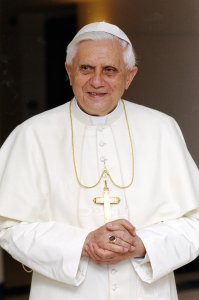
VATICAN CITY (CNS): Pope Benedict XVI announced he is establishing a pontifical council for new evangelisation to find ways “to re-propose the perennial truth of the Gospel” in regions where secularism is smothering church practice.
Leading an evening prayer service on June 28 at Rome’s Basilica of St Paul Outside the Walls, Pope Benedict said there were areas of the globe that have been known as Christian for centuries, but where in the past few centuries “the process of secularisation has produced a serious crisis” in people’s sense of what it means to be Christian and to belong to the Church.
“I have decided to create a new organism, in the form of a pontifical council, with the principal task of promoting a renewed evangelisation in the countries where the first proclamation of faith has already resounded and where there are churches of ancient foundation present, but which are living through a progressive secularisation of society and a kind of ‘eclipse of the sense of God’,” he said.
The challenge, he said, was to find ways to help people rediscover the value of faith.
The Pope named Italian Archbishop Rino Fisichella as president of the Pontifical Council for Promoting New Evangelisation. Archbishop Fisichella has been president of the Pontifical Academy for Life.
Pope Benedict made the announcement about the new council at the basilica built over what is believed to be the tomb of St Paul, who dedicated “his entire existence and his hard work for the kingdom of God”, the Pope said.
The Pope’s evening prayer service marked the vigil of the feast of Sts Peter and Paul, the Vatican’s patron saints and the symbols of the Church’s unity and its universality, he said.
Saying he wanted to focus the evening service on the universal aspect of the Church, Pope Benedict recalled how Pope John Paul II repeatedly used the phrase “new evangelisation” to describe the need for a new commitment to spreading the Gospel message in countries evangelised centuries ago and the need to find new ways to preach the Gospel that correspond both to the truth and to the needs of modern men and women.
The Pope said the social and religious challenges of the modern world cannot be met by human strength and ingenuity alone. In fact, he said, he and other Church leaders often felt like the disciples of Jesus faced with a hungry crowd but having only a few fish and a couple loaves of bread to divide among them.
“Jesus showed them that with faith in God nothing is impossible and that a few loaves of bread and fish, blessed and shared, could satisfy everyone,” he said.
“But there wasn’t – and there isn’t – only hunger for material food: There is a deeper hunger, which only God can satisfy,” the Pope said.
Men and women today want “an authentic and full life, they need truth, profound freedom, unconditional love. Even in the deserts of the secularised world, the human soul thirsts for God,” he said.
Welcoming a delegation from the Ecumenical Orthodox Patriarchate of Constantinople, the Pope said the task of new evangelisation also was tied to the commitment to working for Christian unity.
“May the intercession of Sts Peter and Paul obtain for the whole Church an ardent faith and apostolic courage to announce to the world the truth we all need, the truth that is God,” the Pope prayed.